The Story⚡
A female-led musical, Evi, opened in Nigerian cinemas on 27 March 2026. Despite a well-attended Lagos premiere and an original soundtrack released ahead of the film, it has so far struggled to draw large crowds, with its total gross remaining below the ₦50 million mark weeks into its run.
Tell Me More
Evi tells the story of Evi-Oghene Donalds, a talented but arrogant Afrobeats artist whose world collapses when her label drops her without paying what she is owed. Left without income or the identity she built around fame, she must rebuild her career and her sense of self with help from her best friend and a struggling manager.

The project is written and directed by Uyoyou Adia. It is produced by Judith Audu Productions in collaboration with Switch Visuals Productions. Osas Okonyon makes her feature film debut in the lead role, supported by Uzor Arukwe, Omowunmi Dada, Ibrahim Suleiman, Waje Iruobe, and others, including Femi Branch and Ariyike Owolagba. An original soundtrack featuring female voices in Afrobeats was released ahead of the film on major platforms.

The production positioned Evi as a bridge between Nollywood storytelling and Afrobeats music, with concert scenes filmed using high-end cinema equipment. A well-attended black-carpet premiere took place on 22 March 2026 at Filmhouse Cinemas IMAX Lekki in Lagos, drawing industry figures and generating positive early reactions focused on its emotional depth and musical integration.

Despite these elements, theatrical performance has remained modest. It recorded an opening week of ₦16.9m. The film continued screening into April but had not crossed the ₦50 million mark yet. Several factors help explain this outcome in the context of the 2026 Nigerian box office.
First, the market shows a pronounced winner-takes-most pattern. The overall West African box office has grown significantly, with rising ticket sales and admissions. However, revenue concentrates heavily among a small number of high-profile releases, often from established directors with strong audience loyalty and aggressive marketing. Mid-tier or debut-led films frequently secure limited screen time after opening weekends, as cinemas prioritize titles that continue drawing consistent crowds.

Second, audience behavior in an economically pressured environment plays a role. Cinema tickets represent a notable expense for many Nigerians, leading viewers to be selective. They tend to concentrate spending on films perceived as high-event or reliably entertaining, often favoring proven commercial formulas involving major comedy stars or broad-appeal blockbusters. Evi’s focus on drama, ego, loss, and redemption in the music industry, while incorporating music, may not have aligned as strongly with the preferences dominating peak attendance periods.

Third, marketing and visibility challenges affect newer or genre-blending projects. Although Evi benefited from a targeted premiere and soundtrack rollout, it entered a crowded March–April slate that included other local titles holding strong in subsequent weeks. Without the massive pre-release hype or star power associated with the industry’s top earners, sustaining momentum beyond the first weekend proved difficult. Reports from the period highlight how even films with solid openings can see rapid drops if word-of-mouth does not translate into repeat or widespread attendance.
Fourth, structural issues in distribution and exhibition contribute broadly. Limited cinema infrastructure (around 122–135 screens nationwide) means competition for slots is intense. Films without exceptional holdover performance risk being pulled or given fewer showtimes. Broader industry discussions also note the impact of piracy on overall revenue confidence, though its direct effect on theatrical runs is secondary to initial audience turnout. Additionally, the integration of music into drama did not appear to create the crossover draw that some expected, possibly because Afrobeats audiences engage more readily through digital streaming and live events than through theatrical musical narratives.

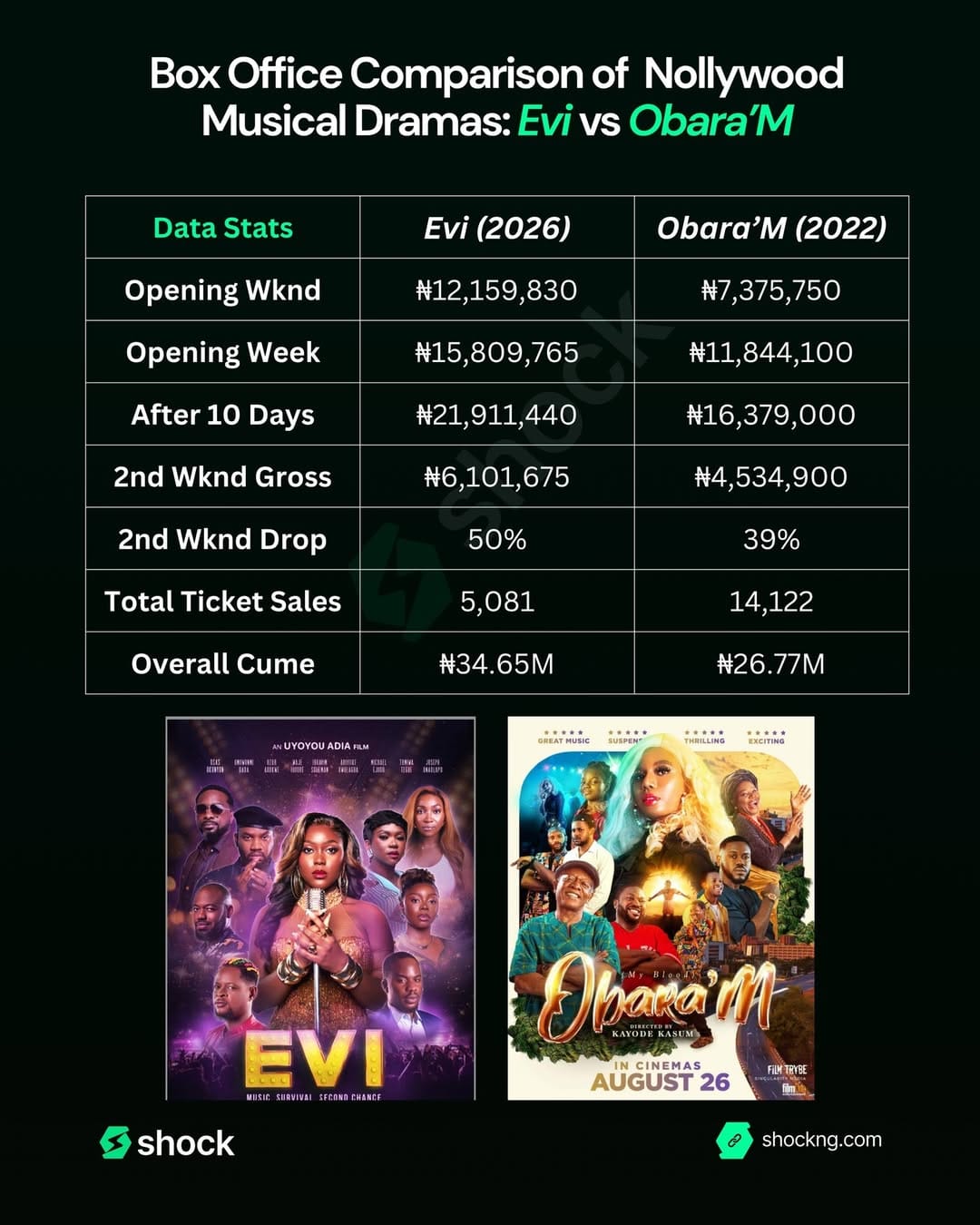
Box Office Performance Comparison Of Musical Dramas
The table below compares Evi with Obara’M (2022), another Nollywood musical drama centered on a female musician’s personal struggles.
Metric | Evi (2026) | Obara’M (2022) |
|---|---|---|
Opening Weekend | ₦12,159,830 | ₦7,375,750 |
Opening Week | ₦15,809,765 | ₦11,844,100 |
After 10 Days | ₦21,911,440 | ₦16,379,000 |
2nd Weekend Gross | ₦6,101,675 | ₦4,534,900 |
2nd Weekend Drop | 50% | 39% |
Total Ticket Sales | 5,081 | 14,122 |
Overall Cume | ₦34.65 million | ₦26.77 million |
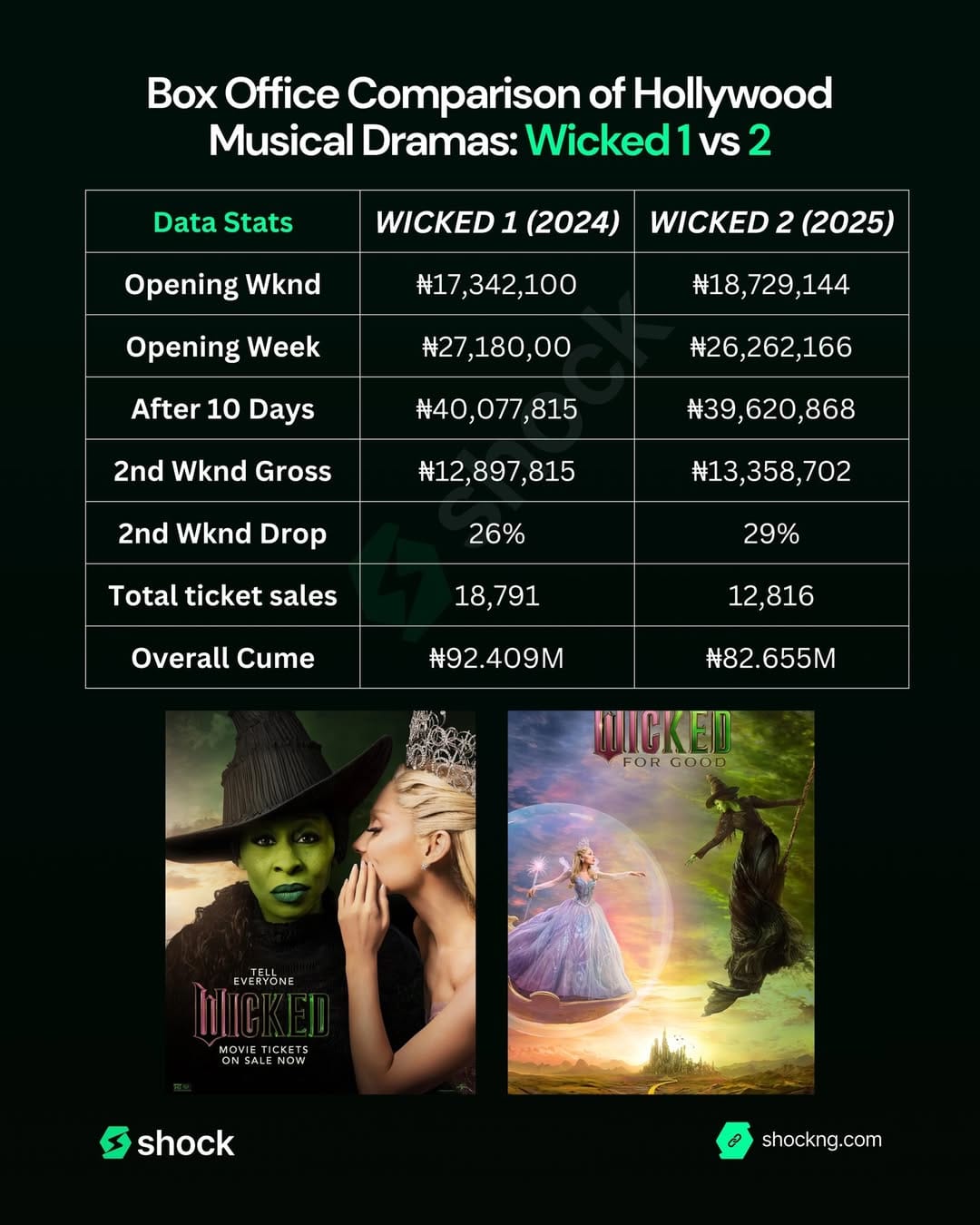
For a broader context, here is how two Hollywood musicals performed in the Nigerian market:
Metric | Wicked (2024) | Wicked: For Good (2025) |
|---|---|---|
Opening Weekend | ₦17,342,100 | ₦18,729,144 |
Opening Week | ₦27,180,000 | ₦26,262,166 |
After 10 Days | ₦40,077,815 | ₦39,620,868 |
2nd Weekend Gross | ₦12,897,815 | ₦13,358,702 |
2nd Weekend Drop | 26% | 29% |
Total Ticket Sales | 18,791 | 12,816 |
Overall Cume | ₦92.409 million | ₦82.655 million |
In Summary
Whether the film will pick up further depends on several variables. Strong positive word-of-mouth could drive gradual increases if audiences who have seen it recommend it more broadly, particularly given its musical elements and emotional storytelling. Continued screenings under FilmOne distribution provide an opportunity for additional earnings, especially if competing releases begin to taper off.

Thanks for Reading.
Shockng.com covers the big creators and players in the African film/TV industry and how they do business.
Let’s be friends on Instagram @Shockafrica