The Story⚡
Nollywood is earning more money than ever before from the big screen, yet the total number of people buying tickets has fallen. What if a film industry could earn more money by selling tickets to fewer people? Nollywood’s box office data reveals exactly that shift.

Tell Me More
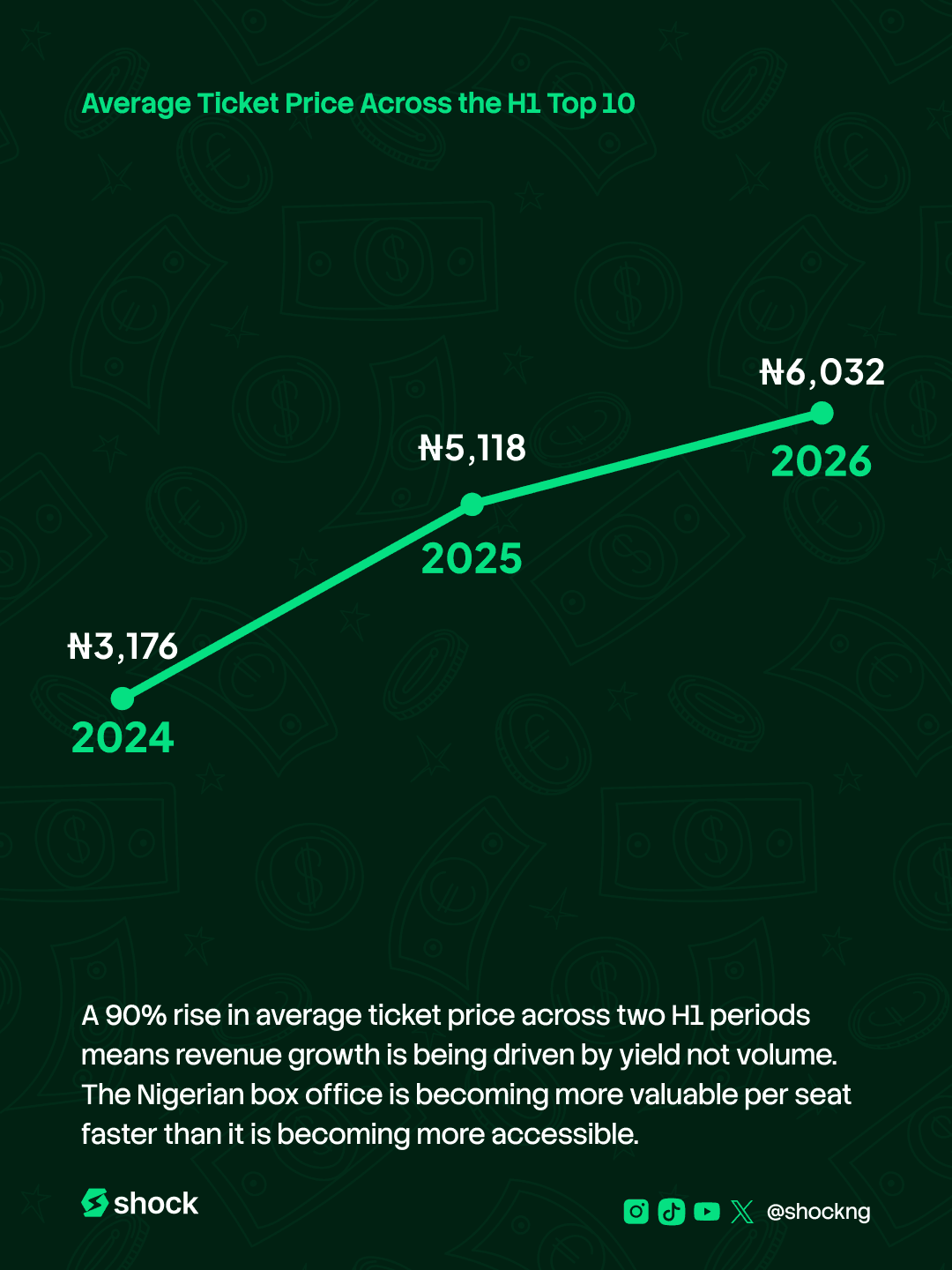
The Nigerian film industry, long celebrated for its volume and cultural reach, is undergoing a measurable transformation in its theatrical segment. Between the first half of 2024 and the first half of 2026, average ticket prices across the top 10 films rose by approximately 90%, from ₦3,176 to ₦6,032. This increase has driven record gross revenues even as total admissions for the top 10 titles fell from 414,160 in H1 2025 to 374,173 in H1 2026.
This divergence between revenue and reach represents one of the most significant developments in recent Nollywood exhibition history. It points to a market maturing toward higher yield per viewer rather than volume expansion.
Peak Performance Reaches New Heights
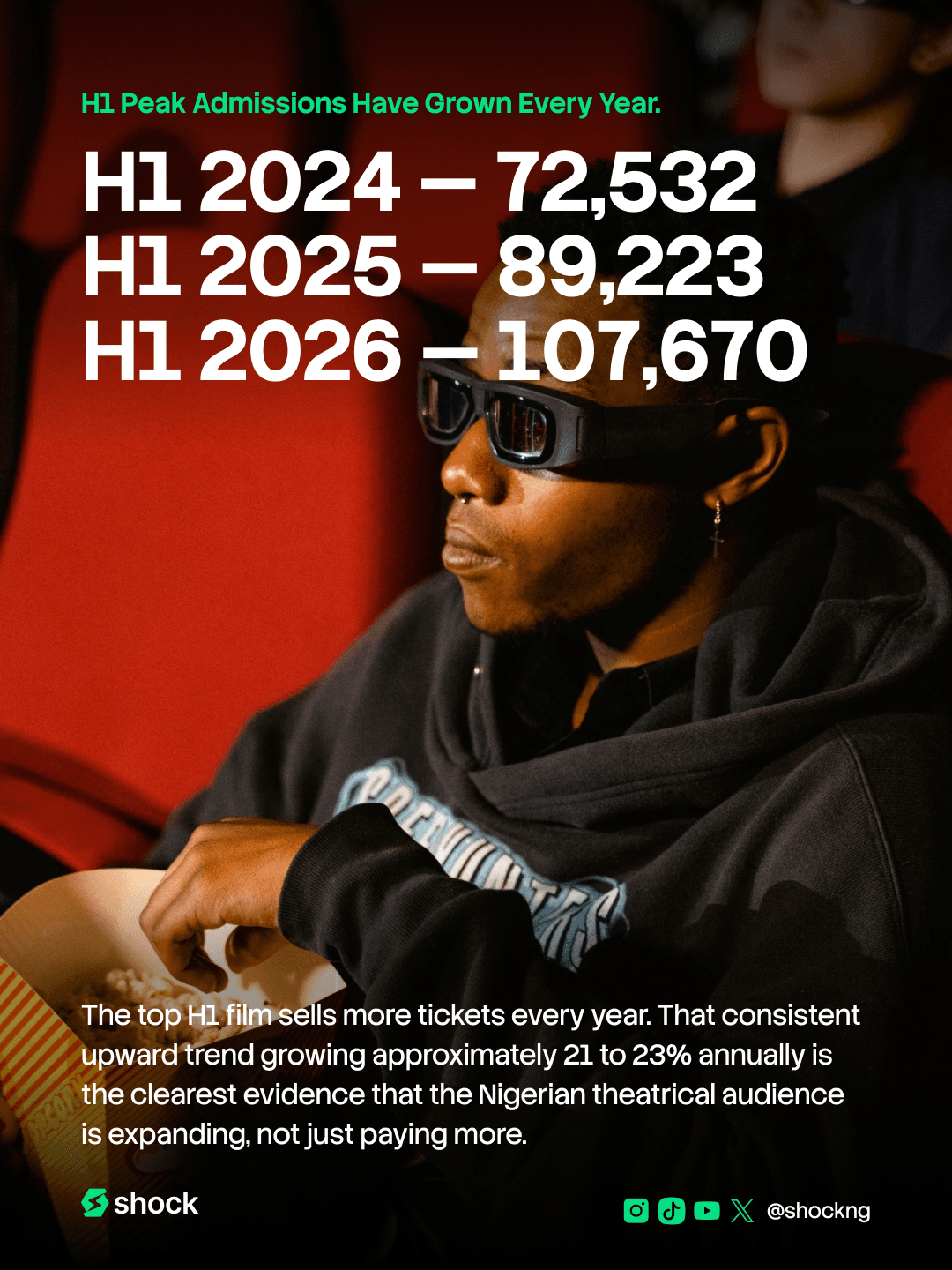
Individual blockbuster performance continues to strengthen. Call Of My Life achieved 107,670 admissions in H1 2026, becoming the first Nollywood film to cross the 100,000-admission mark in any first-half period across the three years reviewed. This represents steady growth in peak admissions: 72,532 in H1 2024, 89,223 in H1 2025, and now 107,670. Year-on-year growth in the top film’s reach has hovered between 21% and 23%.
The top three films by admissions also led in cumulative gross, showing alignment between audience numbers and revenue at the highest levels:
Call Of My Life – 107,670 admissions, ₦719.8 million cume
Love And New Notes – 68,766 admissions, ₦400.5 million cume
The Return Of Arinzo – 61,855 admissions, ₦351.5 million cume
The Pricing Dynamic
The core driver of revenue growth is clear from the average ticket price trend.
| Year | Total Top 10 Admissions | Peak Admissions | Avg Ticket Price (₦) |
| 2024 | 333,396 | 72,532 | 3,176 |
| 2025 | 414,160 | 89,223 | 5,118 |
| 2026 | 374,173 | 107,670 | 6,032 |
The 90% rise in average ticket price over two years has more than offset the moderation in total admissions. In H1 2026, the market extracted significantly more value per seat sold. Several films exceeded the period average, with Iwe Ala recording an implied ₦6,586 average over its first four weeks, suggesting effective premium positioning.
This pricing environment raises questions about accessibility. While higher prices fund better production values, marketing, and cinema infrastructure, they also risk limiting attendance among price-sensitive segments of the audience. The data shows the industry navigating this tension: broader reach for the biggest titles alongside higher per-ticket revenue overall.
Inside the H1 2026 Top 10
The full admissions and gross breakdown for the period provides additional nuance:
| Rank | Title | Distributor | Weeks | Admissions | Cume (₦) | Avg Ticket (₦) |
| 1 | Call Of My Life | F1 NOLLYWD | 9 | 107,670 | 719,841,658 | 6,686 |
| 2 | Love And New Notes | F1 NOLLYWD | 15 | 68,766 | 400,469,044 | 5,823 |
| 3 | The Return Of Arinzo | F1 NOLLYWD | 10 | 61,855 | 351,501,897 | 5,683 |
| 4 | Ajosepo: The Gathering | F1 NOLLYWD | 7 | 27,803 | 164,980,425 | 5,934 |
| 5 | Onobiren | F1 NOLLYWD | 15 | 22,300 | 138,340,673 | 6,204 |
| 6 | Efunroye | F1 NOLLYWD | 10 | 21,827 | 114,889,200 | 5,263 |
| 7 | The Creek | BLUE PICS NOLL | 9 | 21,827 | 108,146,532 | 4,955 |
| 8 | Mother’s Love | NILE NOLLY | 11 | 16,791 | 103,094,664 | 6,140 |
| 9 | The Boy Who Gave | NILE NOLLY | 9 | 14,083 | 82,393,225 | 5,851 |
| 10 | Iwe Ala* | F1 NOLLYWD | 4* | 11,252* | 74,093,920* | 6,586* |
*Note: Iwe Ala released June 12, 2026. Data reflects only four weeks up to the July 5 cutoff; the film remained in cinemas.
Notable observations include identical admissions totals of 21,827 for Efunroye and The Creek, a precise match despite different distributors, release timing, and final grosses. Iwe Ala‘s early high average ticket price suggests a strategy focused on premium screens, though the full performance picture will emerge later.

Longer runs did not always guarantee higher admissions. Love And New Notes and Onobiren both played for 15 weeks yet delivered markedly different results, highlighting the importance of content appeal and marketing alongside screen count and duration.
Implications for Stakeholders
For producers and distributors, the data underscores the value of pricing power. Films that command higher ticket prices, through genre, star power, technical quality, or premium formats, can achieve strong financial outcomes even with moderate audience numbers compared to previous peaks.
Cinema operators benefit from higher per-ticket revenue, which can support investments in comfort, sound, projection, and concessions. However, sustained price increases require corresponding improvements in the theatrical experience to justify the cost to audiences.
Brands and sponsors evaluating partnerships now face a clearer distinction between gross revenue and actual audience reach. A ₦114 million gross and a ₦108 million gross may represent similar numbers of people reached. Understanding admissions data alongside box office figures becomes essential for measuring marketing value and cultural impact accurately.
The overall trend suggests a theatrical market that is becoming more premium-oriented. This mirrors patterns seen in other film industries where post-pandemic recovery involved higher prices and more selective attendance. Nollywood appears to be following a similar path, leveraging growing production ambition and audience willingness to pay for standout experiences.
Yet challenges remain. Total admissions in H1 2026 trailed H1 2025 despite higher peaks and prices. Expanding the audience base, through more cinemas, targeted pricing strategies, or improved distribution to secondary cities, could complement the yield focus. The industry must balance revenue maximization with broad accessibility if it aims to deepen its cultural footprint.
In Summary
The consistent growth in peak admissions shows that compelling stories can still draw significant crowds. Call Of My Life‘s milestone performance sets a new benchmark and likely raises expectations for future releases. At the same time, the pricing trajectory indicates that the economics of exhibition are shifting.

Thanks for Reading.
Shock Africa is an African cinema trade publication. Analysis is based on Nigerian theatrical box office data from January to March 2022- 2026, covering new releases only. Full data set available on request, shockng.com
Let’s be friends on Instagram @Shockng