The Story⚡
Hundreds of actors, crew members and producers marched to Parliament in Cape Town and the Department of Trade, Industry and Competition (DTIC) offices in January 2026, demanding urgent fixes to a rebate system that has left the local screen industry unable to green-light new projects for nearly two years.

Tell Me More
South Africa’s film and television production incentive, administered by the DTIC, refunds qualifying local and international productions a portion of their spending (typically 25 % or more) to encourage job creation and economic activity. The scheme helped turn the country into a competitive filming destination before 2020, supporting direct employment for around 30,000–60, 000 people and generating an annual production value estimated at R8–10 billion.
Since the COVID-19 shutdown, the sector has contracted sharply. Reliable industry data show employment in full-time-equivalent roles fell from 4 943 in 2021 to 884 in 2024, an average annual drop of 43.6 %. Overall production investment slid from more than R6 billion in 2021 to roughly R962 million in 2024. Foreign direct investment losses linked to the incentive’s problems have been placed at around R3.8 billion.
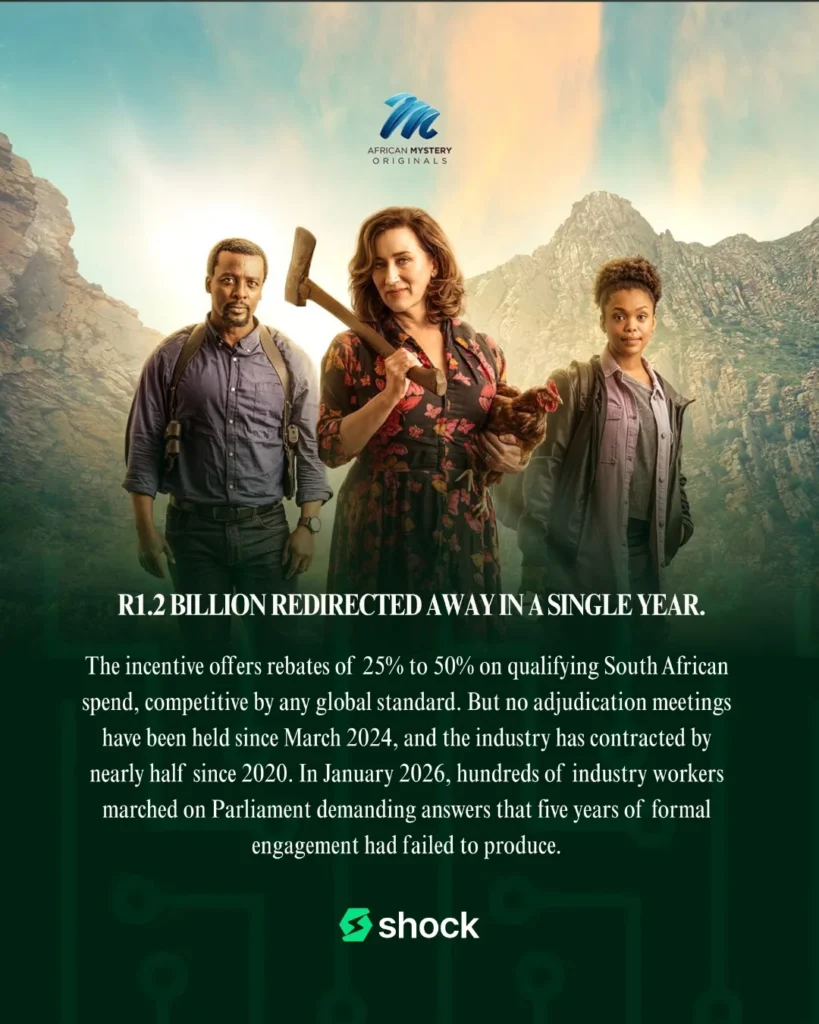
The immediate trigger is a complete halt in new approvals. The DTIC’s adjudication panel last met in March 2024; no projects have been approved in the 2024/25 or 2025/26 financial years. A backlog of unpaid rebates, estimated between R600 million and R1 billion, remains outstanding despite court orders and earlier commitments. The department cut the incentive budget by R136 million in 2023/24 and has described the programme as still “open”, but producers say the absence of adjudication meetings has frozen the pipeline.
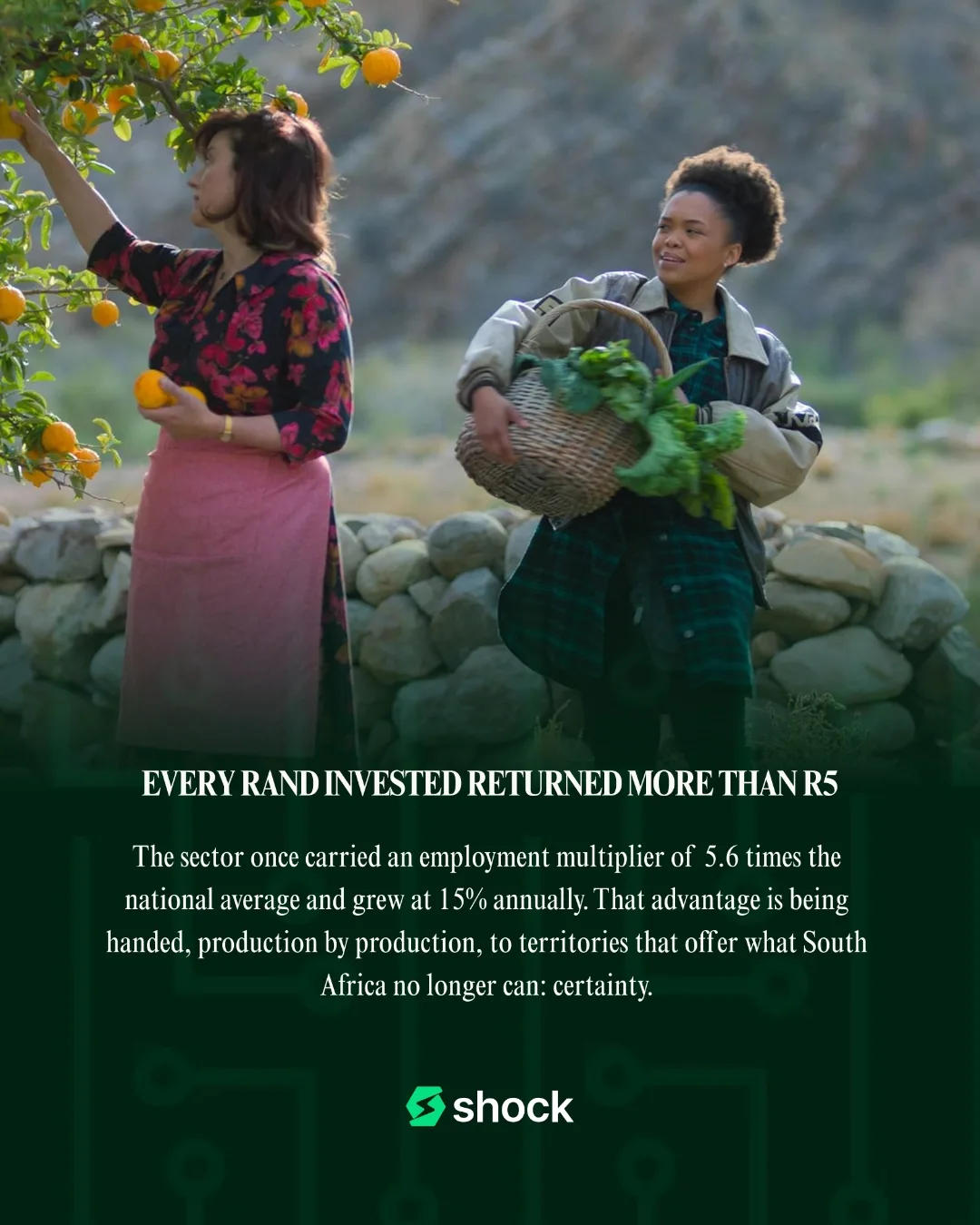
Under the banner #SaveSAFilmJobs, the Save SA Film Jobs Coalition, representing guilds, producers’ organisations and crew unions, has staged repeated demonstrations. In January 2026, they delivered a memorandum calling for immediate adjudication meetings, payment of the backlog and clearer guidelines. Industry representatives emphasise that the problem is not talent, locations or infrastructure, but the lack of certainty. Without predictable rebate decisions, producers cannot budget reliably, international partners walk away, and local crews lose contracts.
One production cited by campaigners illustrates the stakes. The series Recipes for Love and Murder completed two seasons in South Africa, secured distribution in more than 100 countries and ranked on Acorn TV. According to the campaign, it received zero rand in rebates. Producers are now weighing whether to film a potential third season in Ireland or Scotland instead.

The DTIC has acknowledged the backlog and stated it is seeking interim funding while rebuilding capacity. Parliament has heard calls for an investigation into the programme’s administration. As of early 2026, however, no new approvals have been announced, and the uncertainty continues.
In Summary
As the #SaveSAFilmJobs protests make clear, the real issue is not a shortage of talent or locations but simple certainty. Without it, even successful local shows like Recipes for Love and Murder are looking overseas. Will restoring timely approvals be enough to bring the work back before the damage becomes permanent?

Thanks for Reading.
Shockng.com covers the big creators and players in the African film/TV industry and how they do business.
Let’s be friends on Instagram @Shockafrica