The Story⚡
In this conversation, multidisciplinary artist Oluwakeyede explains why African animation needs stronger support and how authentic storytelling can reshape global perceptions of the continent.
Tell Me More
Can you introduce yourself to us and tell us a bit about yourself?
My name is Oluwakeyede. For short, Keyede. I moved to Canada when I was 17, and since then, I’ve done a few things. I went to school, and I graduated as a nurse. While I was doing that, I wrote a dissertation in a book with someone else, and it was published. It was in a gallery for a while. After that, I moved to Vancouver a few years later, and I worked a bit as a nurse. Then I went back to school again, and I did a major in photography.
And I’ve been painting and doing photography. I mostly do abstract painting and photography. I mostly do dark, thematic photography, and I set up all my set designs myself. Some of my works have been in exhibitions, like three exhibitions. That’s pretty much it about me.
Let’s segue into your support for AFRIFF this year. What inspired you to support AFRIFF’s animation category for the second time?
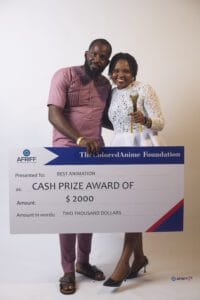
I’ve always loved animation, but I think animation is one of my favourite genres, especially stop-motion animation. I realised that I don’t see much support for it from the African side, and I feel like I’ve seen a lot of talented people on Instagram and TikTok. I figured if people get support and funds to do this, a lot would benefit from it, and more light can be shed on the creative side of people in Africa, Nigeria specifically.
My next question would be in terms of expression as an artist, which I believe you are yourself. What’s the one thing that you think has influenced your art and the ways you express yourself as a creative?
For me, I am very firm on being real to yourself. Being authentic to yourself as much as possible. I feel like I’ve gotten a few pushbacks where people want me to do a specific style of art because it seems more marketable, and I just don’t believe in it. For lack of better words, it’s like selling your soul just to please other people, and you end up not being happy.
What excites you most about the future of animation in Africa?
I would say being able to create big works like Spider-Man: Into the Spider-Verse. I think bringing that story of, let’s say, for example, a story of the jungle by animation. I think a lot of kids, because it’s an animation, and even adults, would be very interested in it. I think it’s a good way to bring animation in a way that kids would be much more interested in watching animated shows and knowing the story about our origin, our forefathers, and stuff like that.
I think now is also a good time to ask you, in terms of our ancestry and our history as Africans, and how that has shaped the world, what do you think is currently the influence of African arts on a global perspective?
I think African art has a lot of global impact. However, I think it’s been whitewashed a lot, especially on the Western side. I also think there is a watered-down version of our history and stories. They enjoy taking our stories, but they water them down for their own version and bury the actual origin of the story. It’s part of the global impact where a lot of people think a lot about the influence, regardless of the conversation of if it is in Africa or if it is not in Africa.
In terms of the African stories that we currently have and you would like to see, what African stories do you enjoy currently, and what type of African stories do you think we should be creating more of as a continent?
I think as a continent, we need to create more stories about the kingdoms from the African continent. Because when they talk about kingdoms, they talk about the Roman Empire and all of that, but I feel like we’ve never really talked about kingdoms from Africa. There are a lot of rich kingdoms, spiritually and money-wise, that existed way before our own existence. I feel like those stories are never told, and they always only talk about the struggles and how Africa as a continent is a third-world country. I mean, it’s true, but that’s the first thing they say when they talk about Africa. I feel like we need to do better by bringing up that history and being loud about that.
Thank you very much for that. So, let’s take the question a little bit further. There have been conversations about the impact of AI, technology, and whatnot. So, I would like to ask you: how do you see technology shaping African animation in the next decade?
On the aspect of AI, I personally don’t like it, especially when it comes to art. I mean, it affects other areas too, but when it comes to art, I really do not like AI because I feel like there are people who call themselves AI artists, and that is not a true artist. That’s just you clacking on your keyboard and writing words, and then artificial intelligence is pulling from other people’s work on the internet, and then you say you’re an AI artist. I know technology and art, at some point, come in handy. However, I feel like AI in art is beginning to blur the lines between actual artists who produce actual work, and I just don’t think those two things should be put together and called art.
What future do you envision for your support of African animators?
My support is basically, hopefully, other artists see that you can get support for what you love, even if what you like to do as an artist is something a little bit unorthodox. I feel like in African countries, it might be a little bit unorthodox to go with animation. So, I feel like if they see there’s support for it, it would give them at least, even if it’s just one person, the courage to continue to pursue that. Hopefully, they are also able to get out there and create something beautiful.
Lastly, what advice would you give to emerging African creatives exploring new art forms?
I would say go for it, but make sure you’re also open to learning the good and the bad side of it, and don’t be closed-minded. If other people have opinions, listen to them, even if you don’t think it’s great. Just listen to it. Stay true to what you want to create, but also learn as you go, because life itself is a journey, which makes your art also a journey. No matter how good you are or how good you think you are, you can always learn something new, even if it’s just a little bit from someone.
Awesome. Thank you so much, Keyede, for your time with us.
In Summary
Animation is emerging as a vital part of the Nigerian film industry, gaining recognition and momentum with each passing year. With the commitment and contributions of individuals like Keyede, the industry is better positioned to grow, attract support, and achieve long-term success.
Thanks for Reading.
Shockng.com covers the big creators and players in the African film/TV industry and how they do business.
Let’s be friends on Instagram @Shockafrica