The Story⚡
In an exclusive interview, Bryan Okoye opens up about resisting typecasting, embodying madness with dignity, and the physical and emotional cost of transformation in the Africa Magic series Etiti.

Tell Me More
When Bryan Okoye was first offered the role of a madman in Etiti, his response was cautious rather than eager. The Africamagic production, produced by Basketmouth and directed by Daniel Oriahi, came with weight, but also risk. For Bryan, the concern was simple and familiar: would this role limit him? And what impact would portraying a madman have on the story in the grand scheme of things?
In an industry where labels stick quickly, the idea of being known primarily as “the madman” felt restrictive. But that hesitation faded once he read the script. What appeared on the page was not a one-dimensional character, but a deeply layered role that demanded range, restraint, and emotional intelligence.
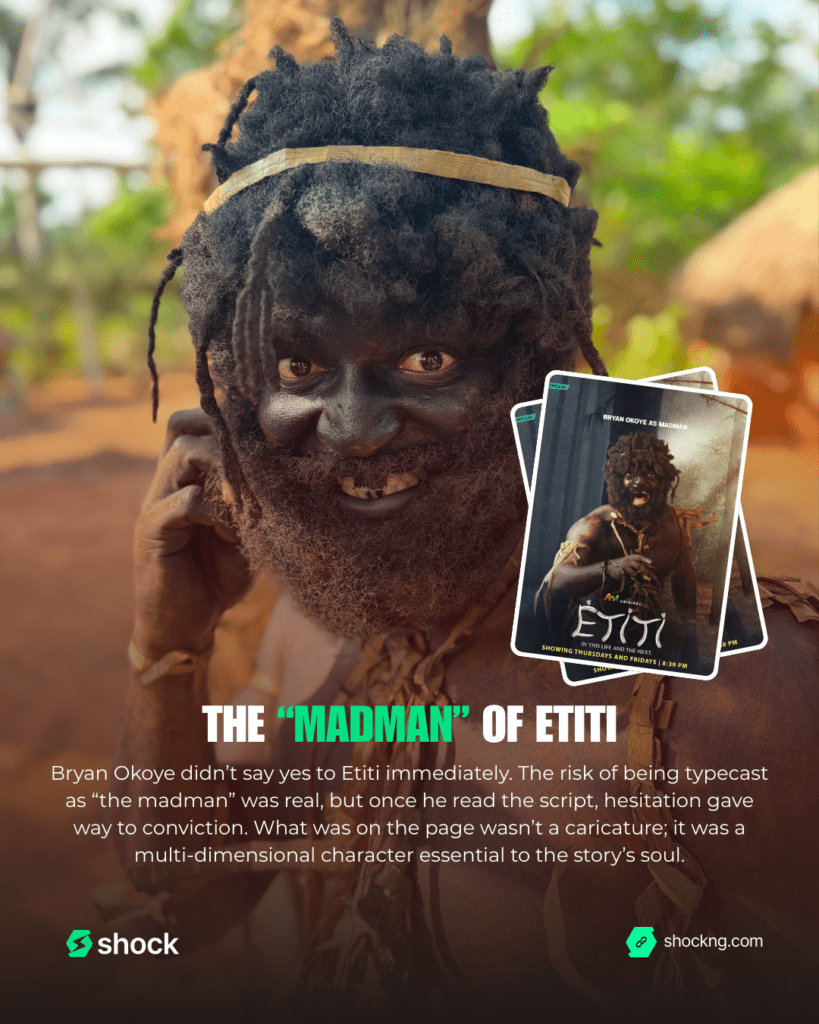
In Etiti, Bryan plays three interconnected personas: the madman shunned by society, a fallen prince gradually regaining sanity, and a king who narrates the story. Rather than narrowing his career path, the role expanded it. It required him to move between fractured reality, recovery, and authority, sometimes within the same narrative breath.
For Bryan, the casting itself was significant. He praised the producers for looking beyond physical appearance and industry stereotypes, choosing ability over assumptions. It was a rare opportunity to escape the familiar boxes of “lover boy” or “boy next door” roles that many actors struggle to shed. Throughout his career, Bryan has been intentional about avoiding such limitations, taking on diverse characters ranging from hunters and police officers to pastors and morally complex figures.
A key factor in his ability to take on such a demanding role was his long-standing creative partnership with director Daniel Oriahi. Their collaboration dates back to 2018, when Bryan landed his first lead role. Since then, they have worked together on several projects, including My Name Is Azed, The Weekend, and Black Pepper, building a relationship rooted in trust and a shared creative vision. That trust allowed Bryan the freedom to explore the madman’s character with nuance rather than fear.

At the center of Etiti is a madman who is anything but disposable. Bryan describes the character as a symbolic bridge between the physical and the spiritual, a prophetic truth-teller dismissed by society yet very essential to the story’s moral compass and plot. He represents voices often ignored: the marginalized, the misunderstood, and those living with mental illness.
To portray this responsibly, Bryan committed himself to extensive research. He spent hours at Yaba Left Mental Hospital, speaking with the Director of Administration and observing patients. These encounters shaped his performance in subtle but powerful ways, from posture and movement to speech patterns and emotional rhythms. His goal was realism, not exaggeration. He also had to do research to come up with a “madman song,” which didn’t exist in the script. That song is the “GbamGbamTiTi” madman song that viewers got used to.
The experience strengthened Bryan’s desire to reveal the humanity that exists within mental illness, the fleeting moments of clarity, the stillness, tenderness, humour, and vulnerability that remind us that behind the condition is still a person, still human, still worthy of empathy.
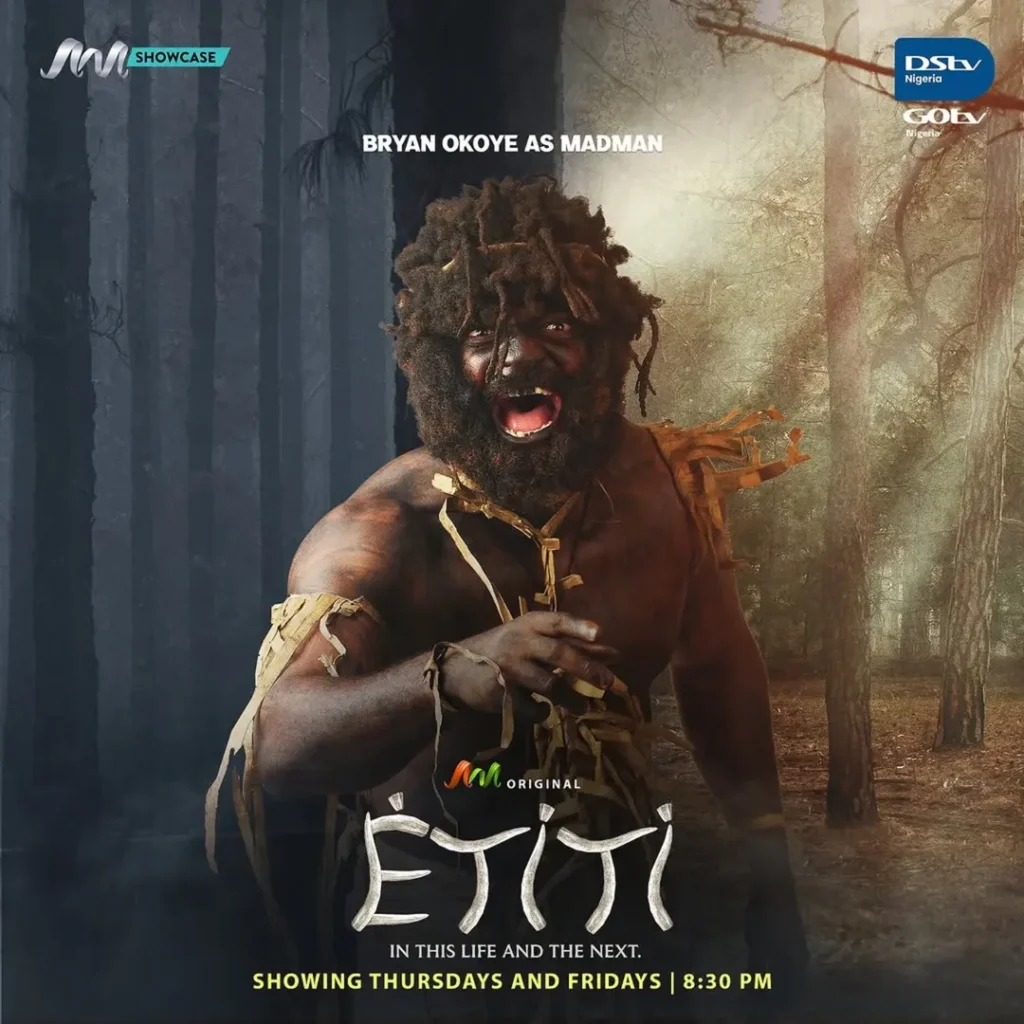
The character’s journey from madness to royalty was treated with particular care. Rather than an abrupt transformation, Bryan portrayed recovery as gradual and fragile. Changes in posture, gait, and eye contact signaled progress, allowing the audience to believe the transition. Madness, in this portrayal, becomes both burden and shield—a survival mechanism that conceals clarity and dignity beneath chaos.
One of the most physically demanding scenes required Bryan to repeatedly draw prophetic symbols with his fingers on the bare ground with growing intensity. The process left him with bruised fingers and a strained voice after multiple takes. It was a moment that captured not just the character’s desperation, but the toll the role took on the actor himself.
That toll extended beyond performance. Daily makeup sessions lasted over an hour and covered Bryan’s entire body, severely restricting movement. To protect the makeup, he was often fed on set. After filming, removing it required an additional 30 minutes of showering, adding to the exhaustion.
The shooting schedule further tested his endurance. Bryan frequently moved between scenes as the madman and scenes as his other characters, forcing him to switch emotional states rapidly. Maintaining consistency under such conditions demanded discipline and focus. He credits the makeup team for their meticulous work, noting that their efforts helped ground his performance despite the discomfort.
Since entering the industry in 2018, Bryan’s journey has been shaped by persistence, endless auditions, rejection, and a refusal to take shortcuts. That commitment has led to growth and international recognition. This includes winning the 2022 Septimius Award Nomination for Best African Actor, and recently winning the Best Supporting Actor award at the Crown Point International Film Festival in Chicago for his role in For Ikemefuna, a South African/Nigerian film that addresses xenophobia. The film also received Best Feature Film at the Orlando Urban Film Festival.

Bryan remains clear about his path. He is drawn to roles that challenge him emotionally and physically, as he has acted as a hunter, pastor, police officer, taxi driver, prince, and now a prophetic madman-turned-king. He is open to feature in action movies and impactful stories, and he is still in a continued pursuit of directors who value depth and risk.
With Etiti, Bryan Okoye redefines what a “madman” can represent on screen. His performance is not built on spectacle, but on empathy, vulnerability, nuance, restraint, and transformation. Overall, Bryan Okoye is carving out a career driven by intention.
In Summary
Bryan Okoye considers Etiti a defining milestone in a career that began in 2018 with relentless persistence, endless auditions, repeated rejections, and a steadfast refusal to take shortcuts. With this, he is steadily carving a career built on purpose and powerful performances.
You can catch Etiti on Africa Magic Showcase (DStv Channel 151) or stream and binge all episodes anytime on Showmax.

Thanks for Reading.
Shockng.com covers the big creators and players in the African film/TV industry and how they do business.
Let’s be friends on Instagram @Shockafrica